Tuesday, January 12, 2016

Measurements and counts- Sturgeon at TNACI by Claire C.

Sadly, November 4 was our last trip to TNACI. For this final trip, we learned about how ichthyologists are tracking endangered species of fish, particularly the Pallid and Shovel Nose sturgeon, and how they’re managing to prolong the survival of their species. The Pallid sturgeon, which is indigenous to the northern Missouri and the waterways in that vicinity, are dying out due to the construction of dams on the Mississippi.

As it turns out, the Pallid sturgeon has started interbreeding with the Shovel Nose sturgeon. Since sometimes it is hard to tell which is which when they interbreed, ichthyologists like Dr. Bernie Kuhajda are currently trying to discern how many hybrids and purebreds are in nature by comparing the fishes physical and genetic characteristics. 
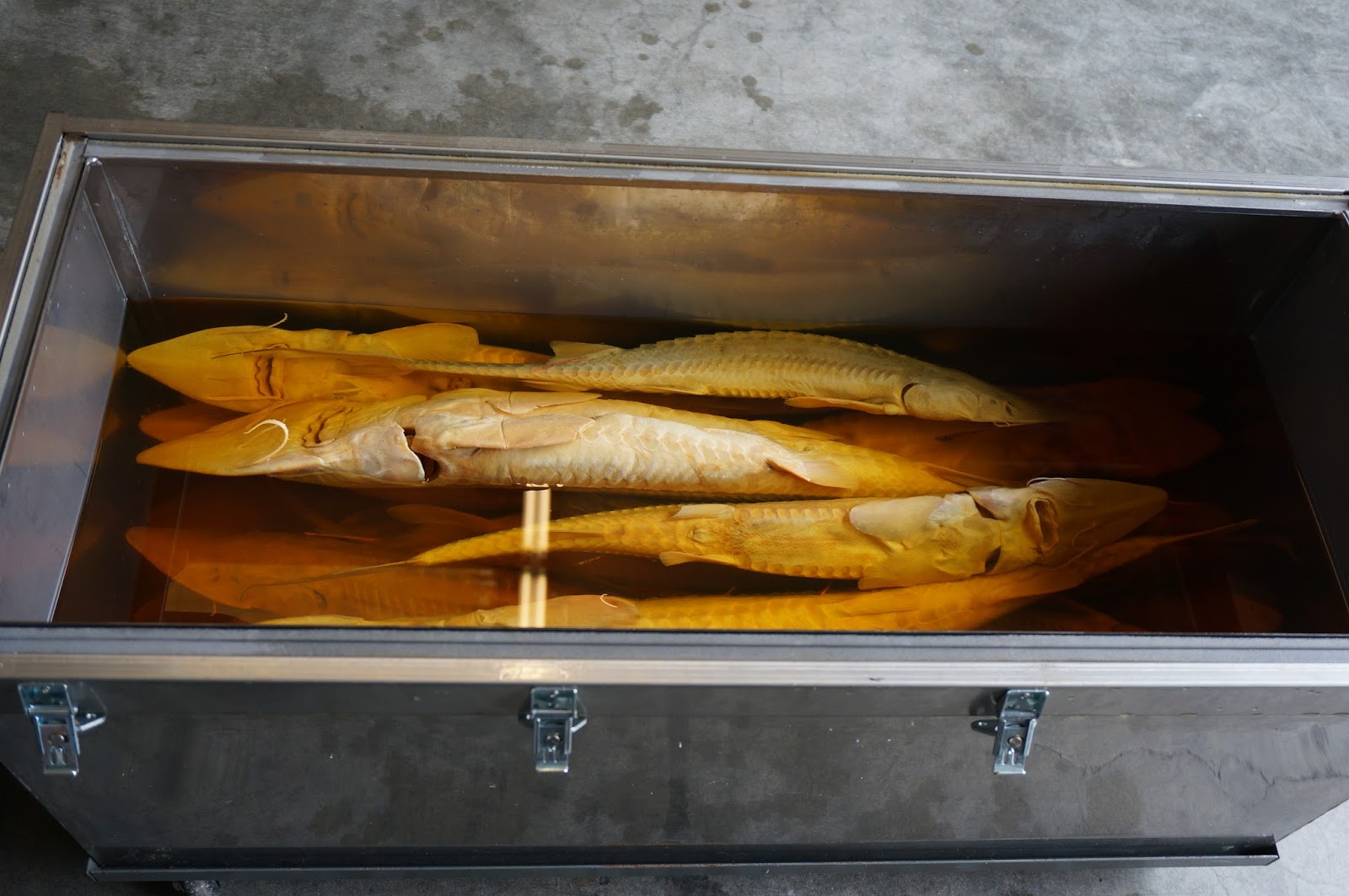


To determine the physical qualities, he takes 39 measurements that include the distance from head to tail and 9 counts such as the amount of rays on the lower fin. They also use fin tags to track their movement. 


Dr. K says that its tedious work but necessary to determine how to protect the species. Although he loves his job measuring fish, Dr. K also has a passion for cave fish found nowhere else in he world. Some of his recent finds include the Alabama Cave fish, the Southern cave fish, and the cave shrimp, which is found in only one Alabama cave. 

We took turns taking physical measurements and counts as we learned about some characteristics of the Pallid and Shovelnose sturgeon.


Next, we took a short tour of the greenhouse, which was holding Sewanee’s amphibian project. In this experiment, they were testing competition amongst salamanders over a four week period, seeing if they gain or lose weight when fed in a controlled environment.


Friday, November 6, 2015

Sturgeon pre-release measurements by Charlotte V.

On October 7, we took a trip to TNACI with the intention of observing trout spawning. When we arrived, the head of the program told us that the spawning could not take place due to the maturation of the fish. So after we put all the trout back into their tank, one person netted ten sturgeon from each tank, while another would measure each one in millimeters, someone else would measure the fish in grams, and the last person would record all of the data. There are six sturgeon tanks, and the fish are separated into each tank by size. In some tanks there was an average of 200 millimeter fish, while in others there was an average of 90 millimeters. The bigger fish tended to weigh around 20-30 grams, and the smaller fish leaned more towards the 8-12 gram range. The TNACI employees informed us that the smaller fish, because they are the same age as the bigger sturgeon, will also be released tomorrow, even though they might have a lower survival rate.


While we were gathering data about each sturgeon, Shawna Mitchell (Science coordinator @TNACI) taught us about the anatomy of the sturgeon. The sturgeon is a pretty weird looking bottom feeder, native to the Tennessee River. A sturgeon’s mouth lends itself to being a bottom feeder by being on the underside of its body, and being flat, so that it can swim along the river’s bottom picking up different things to eat such as mollusks and other crustaceans.


Another body part that’s important to a sturgeon’s survival is its barbels. The barbels are the things that hang down from its nose that move through the river silt detecting food for the sturgeon to eat. One cool adaptation that the sturgeon has is its ‘glowing’ eyes. They are small and are perched on top of the sturgeon’s head. Because sturgeon live at the bottom of the river where it’s dark, they have to be able to absorb all the light that they can and be able to reflect it so they can see. Their eyes do this for them and enable them to see predators, as well as food that might be swimming around.  


Monday, November 2, 2015

Water quality at TNACI - by Larkin B.

Today we went back to TNACI and learned how to test the sturgeon tank water to see if there is any chlorine in it. This type of testing is not normally used when testing in the field, because there is typically not any chlorine in the rivers. Tap water is used in the tanks at TNACI, so the water must be checked and treated. 
 There are 4 tanks we tested, each one is tested to make sure certain chemicals are not building up and creating a toxic environment the fish could not live in. To do this we learned how to test the pH, nitrate, and ammonia levels. 

If the water below pH of 6 or above 8.5 the water in the tank must be changed, because it is a harmful environment for the fish. 


The ammonia in the tank should be as close to zero as possible and this varies with temperature and pH. These parameters were tested using an spectophototometer and ionized water was used as the control. 


On our way out, the TNACI interns explained to us how the invasive mosquito fish is being measured as part of a study of its impacts on the barrens topminnow.    

Tuesday, September 15, 2015

Sturgeon Re-introduction program at TNACI by Claire C.

Tasty bloodworm lunch
Today, we took a trip to the Tennessee Aquarium Conservation Institute (TNACI) propagation facility to observe how they breed and care for the sturgeon. Sturgeon are a type of bony fish indigenous to the Tennessee River, but have been overfished for caviar and blocked from their natural breeding grounds by dams or other industrial works. This caused the population to decrease significantly. TNACI, as well as many others, have noticed this problem and are attempting to resolve it by spawning the sturgeon in captivity, which can increase the survival rate of the developing fries.

To do this, they pump in city water rather than using a flow-through system and de-chlorinate it before filling the tanks. There are about 5-6 tanks, which separate the sturgeon based on size. The reason behind this is to ensure that the bigger and smarter fish will not deprive the smaller ones of food. Typically, the smaller ones would never make it in the wild due to their size and intelligence.


For a balanced diet, the young sturgeon are fed a healthy dose of bloodworms. They're benthic feeders, meaning that they eat their food off the bottom of the tank, which can potentially increase the growth of bacteria. We got rid of this by thoroughly scrubbing the inside of the tank, but not without accidentally hitting a few fish!
 
Scrubbing the tank 
            If the population levels are brought back up to their historic levels, then it would positively affect the environment and economy because the sturgeon could help balance out the river's ecosystem and again be fished as a food source.