Monday, April 11, 2016

Original poetry- Just in Time for Earth Day by Claire C.

After being inspired by the poetry from the first session with Ms. Williams, we then sought to create some of our own. When writing poetry about nature, there are a variety of directions you could go with your ideas. Some choose to create a stunning visual with romantic detailing of their encounters with nature by painting a picture of the scene in the reader’s mind. You could also choose to turn natural objects or their actions into symbols for more abstract ideas such as peace, happiness, change, etc. Possibly, you could bend words so that the beauty and grace of nature is used to advocate for conservation or heightened consciousness of our environment. There are many ways you could incorporate the elements into poetry, it’s just a matter of understanding the natural world and how it balances with the human language, as well as your own perception. Here are a few of our own poems:

Flow
By Larkin B.
The wind burns my face leaving the tops of my cheeks chafed.
Cloth covers my body allowing only two watery eyes to show;
gazing up, I see the trees sway back and forth greeting me.
The naked limbs of the tree allow the sun to creep through and touch my face,
warming me against the bitter cold.
The sound of water racing down the stream whispers in my ear,
trying to be louder than the screams of the wind.
Answering the call I shuffle to the creek,
the mud grabs my foot pulling it deeper and deeper into its murky depths.
Yanking my foot away I reach the water and place my feet into the chilly stream;
I glance to my left and see a beaver dam has succumbed to the untamable force of the water.
 I let the river hold me and the flow of the creek takes me away


Evergreen Trees
By Charlotte V.

Evergreen trees in the winter blue,
Give vibrant rays of color to the barren landscape.
They seem like summer balled up into bark, leaves, and branches.
They are bright, colorful, and inspire happiness even on the dreariest of days.
Their branches, they dance in the rain,
And grow in the mild sunlight,
Their needles perch lazily,
Bathing in the sun’s raw, pale light.
Their roots stretch far beneath the surface,
Twisting a tortuous path among themselves,
To get the water they desperately need into their veins.
Their trunks stand firm, even in the worst winter storms.
They are the glue that holds the branches, needles, and roots together.
These components are what make the tree whole,
They are what makes the tree give life to the death of winter.


While on my nature walk, I found a clump of evergreen trees. I was shocked by how much vibrancy they brought to the dark and barren forest. I began to think of each element of the tree and how it relates back to the tree as a whole, which led to the lines referring to each individual element, the branches, the needles, the roots, and the trunk. I used personification for each element because I think of a tree being more alive, than dormant plants.

Untitled
By Lauren K.
Flowers in her hair
Clouds in her mind
Water in her veins
Lava in her head
Us in her soul
Storms in her heart

She is our mother, Mother of the Earth

Thursday, March 24, 2016

Exploring River Poetry- By Lauren K.

At the end of January, we met with local poet Emma Williams to read some poems related to the river (and nature itself). Throughout our meeting time we discussed various poems such as “The Summer Day” by Mary Oliver, “Riprap”  by Gary Snyder and “The Negro Speaks of Rivers” by Langston Hughes. 


We also read an article (“The Case for Going Uncivilized” by Barry Lopez) based on one man’s perspective of the land being destroyed and taken away. In this story, We met a man named Berry, who grew up with the land. He would hike and play as a child but now all he does reminisce on the times he shared with the trees and land. He says “Like every animal in these woods, I’m adapting. I’m playing the cards I’ve been dealt”. In Berry’s lines, he says how times have changed, and like Mother Earth, we must adapt to our environment.

The fellows ended our session with Ms. Williams, with the assignment of writing our own poetry. We said our goodbyes and went on to write.

Tuesday, January 12, 2016

Measurements and counts- Sturgeon at TNACI by Claire C.

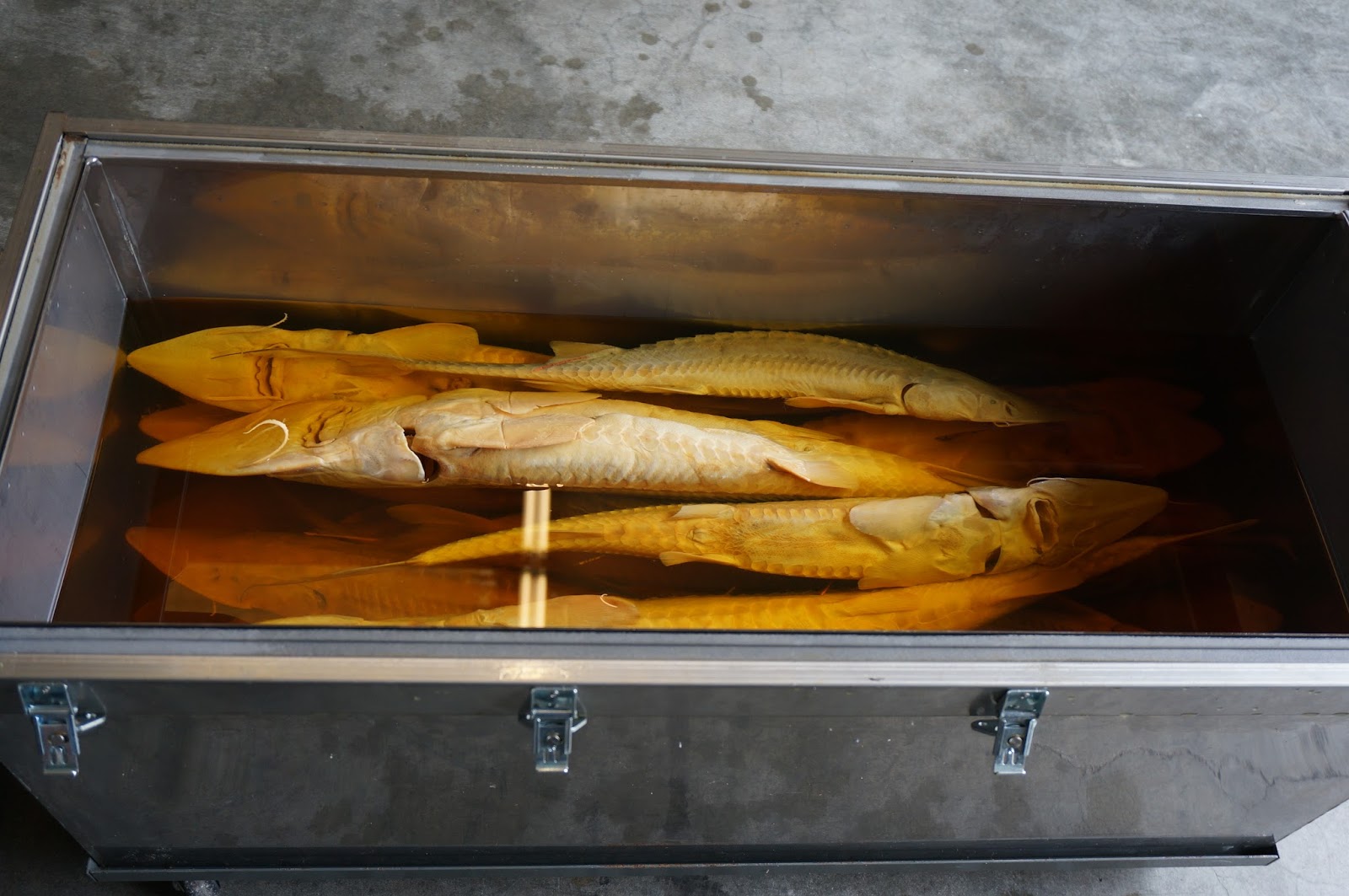
Sadly, November 4 was our last trip to TNACI. For this final trip, we learned about how ichthyologists are tracking endangered species of fish, particularly the Pallid and Shovel Nose sturgeon, and how they’re managing to prolong the survival of their species. The Pallid sturgeon, which is indigenous to the northern Missouri and the waterways in that vicinity, are dying out due to the construction of dams on the Mississippi.

As it turns out, the Pallid sturgeon has started interbreeding with the Shovel Nose sturgeon. Since sometimes it is hard to tell which is which when they interbreed, ichthyologists like Dr. Bernie Kuhajda are currently trying to discern how many hybrids and purebreds are in nature by comparing the fishes physical and genetic characteristics. 


To determine the physical qualities, he takes 39 measurements that include the distance from head to tail and 9 counts such as the amount of rays on the lower fin. They also use fin tags to track their movement. 


Dr. K says that its tedious work but necessary to determine how to protect the species. Although he loves his job measuring fish, Dr. K also has a passion for cave fish found nowhere else in he world. Some of his recent finds include the Alabama Cave fish, the Southern cave fish, and the cave shrimp, which is found in only one Alabama cave. 

We took turns taking physical measurements and counts as we learned about some characteristics of the Pallid and Shovelnose sturgeon.


Next, we took a short tour of the greenhouse, which was holding Sewanee’s amphibian project. In this experiment, they were testing competition amongst salamanders over a four week period, seeing if they gain or lose weight when fed in a controlled environment.


Friday, November 6, 2015

Sturgeon pre-release measurements by Charlotte V.

On October 7, we took a trip to TNACI with the intention of observing trout spawning. When we arrived, the head of the program told us that the spawning could not take place due to the maturation of the fish. So after we put all the trout back into their tank, one person netted ten sturgeon from each tank, while another would measure each one in millimeters, someone else would measure the fish in grams, and the last person would record all of the data. There are six sturgeon tanks, and the fish are separated into each tank by size. In some tanks there was an average of 200 millimeter fish, while in others there was an average of 90 millimeters. The bigger fish tended to weigh around 20-30 grams, and the smaller fish leaned more towards the 8-12 gram range. The TNACI employees informed us that the smaller fish, because they are the same age as the bigger sturgeon, will also be released tomorrow, even though they might have a lower survival rate.


While we were gathering data about each sturgeon, Shawna Mitchell (Science coordinator @TNACI) taught us about the anatomy of the sturgeon. The sturgeon is a pretty weird looking bottom feeder, native to the Tennessee River. A sturgeon’s mouth lends itself to being a bottom feeder by being on the underside of its body, and being flat, so that it can swim along the river’s bottom picking up different things to eat such as mollusks and other crustaceans.


Another body part that’s important to a sturgeon’s survival is its barbels. The barbels are the things that hang down from its nose that move through the river silt detecting food for the sturgeon to eat. One cool adaptation that the sturgeon has is its ‘glowing’ eyes. They are small and are perched on top of the sturgeon’s head. Because sturgeon live at the bottom of the river where it’s dark, they have to be able to absorb all the light that they can and be able to reflect it so they can see. Their eyes do this for them and enable them to see predators, as well as food that might be swimming around.  


Monday, November 2, 2015

Water quality at TNACI - by Larkin B.

Today we went back to TNACI and learned how to test the sturgeon tank water to see if there is any chlorine in it. This type of testing is not normally used when testing in the field, because there is typically not any chlorine in the rivers. Tap water is used in the tanks at TNACI, so the water must be checked and treated. 
 There are 4 tanks we tested, each one is tested to make sure certain chemicals are not building up and creating a toxic environment the fish could not live in. To do this we learned how to test the pH, nitrate, and ammonia levels. 

If the water below pH of 6 or above 8.5 the water in the tank must be changed, because it is a harmful environment for the fish. 


The ammonia in the tank should be as close to zero as possible and this varies with temperature and pH. These parameters were tested using an spectophototometer and ionized water was used as the control. 


On our way out, the TNACI interns explained to us how the invasive mosquito fish is being measured as part of a study of its impacts on the barrens topminnow.