Thursday, June 18, 2015

Creepy food storage tips from the loggerhead shrike

Louisiana water thrush 
After our stormy, sleepless night, we woke early and enjoyed some oatmeal. John and Lizzie had already set the bird nets and collected a bird; it was a migrant called a Louisiana water thrush. It migrates to Central America and breeds in the southern United States. This thrush was banded and we returned close to the collection location to release it - this bird likes to live near the banks of intermittent streams.
getting ready to release the thrush 

post-release 

 The bird nets are fine nets with about 4 pockets positioned perpendicular to the river. Most of the nets were set low and so trap low-flying birds. A canopy net was also set, but we didn’t get any birds collected from this net. The nets need to be checked every 30-45 minutes so after releasing the thrush we walked the nets a second time, where we collected a Carolina Wren- the wren was put beak first into a cloth bag for the return trip to the bird banding station.  While on our walk we encountered a Black Locust tree and Lizzie pointed out the extremely spiky bark. 
Loggerhead shrike- impales food on spikes
We were surprised to learn that a bird called the loggerhead shrike impales frogs and small rodents on the spikes to create a food cache for itself.
Once back at the station, we observed the unhappy wren having wings and beak length measured, weight taken, and a metal band placed around its ankle. This particular bird is a local resident and a juvenile. While in the lab we learned more about some birds that are repeatedly captured and what happens if an already banded bird is caught. John told us of a bird he captured in the Arctic with a Tasmanian tag he looked up. In the databse, he found that the bird was nine years old and had made the journey from the Arctic to Tasmania 9 times!


We also learned about migration in general. Many birds know when to migrate based on length of days (photoperiod). They are able to find their way using stars, magnetic field, land masses and scent.  Often, only 1/2 of the birds that migrate survive. Their travel is threatened by bad weather, hunting/trapping, predators, collisions with windows and light pollution. 
A muddy hike out! 

Back to GPS where we met Leda Goodman from Covenant college and she led us trhough more of the co-lab curriculm.
winning idea with ice cream prize 

working through the canvas- practice pitch #1


Tuesday, June 9, 2015

Camping, bird banding, social entrepreneurship, and storms, oh my!

The first day of the summer experience for the veteran River Fellows was a full one! We spent the morning with an introduction to the co-starters generator, an entrepreneurship model that will be used to help students work through their river action ideas together in a supportive way. The idea is to rapidly uncover flaws in the fellows’ concepts and to quickly find better concepts, which they will then articulate and implement.
transitioning from classroom to trail 


A dry start 

After a morning of identifying passions and generating ideas, we hit the trail for a campout at the Tennessee River Gorge Trust (TNRGT) bird-banding lab. John Diener greeted us with a smile and gave us a glimpse into the globetrotting career of a bird-bander.
 on the way to winning the tent set-up competiton 
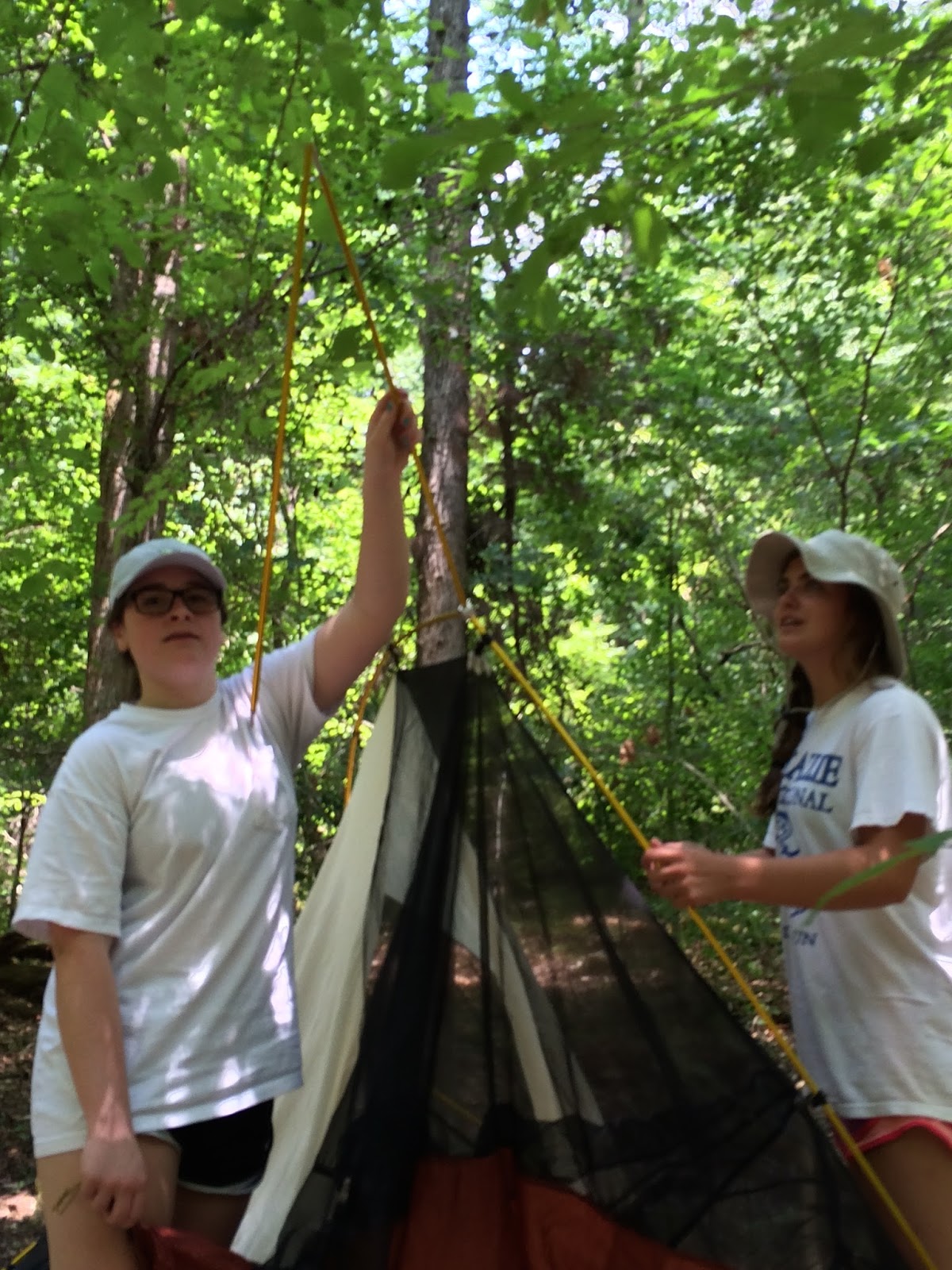
After a tent-setting-up competition and some elaborate hammock hanging, we went out to help John set up the bird capture nets.  Unfortunately, the weather threatened to take a turn for the worse and the nets and hammocks had to be taken back down. 
unset bird capture net (almost invisible once set) 

Setting a capture net
We returned to our co-starters work and identified leadership styles and obstacles to implementing the river action ideas. The storms held off until after we had eaten the wonderful chili dinner prepared by Sunshine from Outdoor Chattanooga.  
TNRGT bird banding lab 

We were able to get a preview of the inside of the bird banding lab while we waited out storm #1 of the evening. While we were hoping for relaxing nature sounds to help us sleep, we instead slept lightly as we were ‘serenaded’ by barred owls, barge horns, intense thunder, lightning and rain. It was quite a night for those new to camping.

Saturday, June 6, 2015

If it hasn't been studied it can't be conserved- Fellows visit crayfish expert and natural history collection at TVA

Jeff Simmons invited the River Fellows to his lab and natural history collection where we learned some surprising and fascinating things about crayfish. Most of us thought there were just a couple of different species of crayfish and we were astounded to learn about the species diversity of this animal. The Tennessee Wildlife Resources Agency reports that of the 550 species of crayfish that occur worldwide, more than 78 of these live in Tennessee which may rank us as having more crayfish species than any other US state. 

We learned that not all crayfish live in streams and rivers. There are some beautiful, brightly colored burrowing crayfish that dig elaborate underground tunnels and take advantage of locations where groundwater is close to the surface. These crayfish build mud chimneys and are difficult to catch, because they can have five or more exits from their burrows. In addition, some crayfish are secondary burrowers and have an entrance from a stream while their networks expand to the riverbank. Crayfish have an important place in an ecosystem as they are a source of food for otters and fish. In turn, they have an omnivore diet and consume small fish and breakdown leaf litter.
Cambarus (Jugicambarus) dubius: Upland Burrowing Crayfish (photo credit: nps.gov)
Invasive species are a constant threat to countless species and crayfish and fish are no exception. Jeff told us about a current political debate related to this issue that is occurring in Kentucky. It is reminiscent of the first court battle to test the endangered species act: the snail darter vs. Tellico dam (you can read more about that case here: http://www.mhhe.com/Enviro-Sci/CaseStudyLibrary/Topic-Based/CaseStudy_TheSnailDarterVersus.pdf) In Kentucky, the dam on the Cumberland River had been broken for seven years during which time many species colonized the now more riverine environment. One of these species was a rare fish discovered during a mussel survey of the area. As was the precedent with the snail darter, this dam was repaired and the habitat for this fish re-flooded. In a survey one year after the habitat returned to slow moving water, the invasive rusty crayfish was found to be the dominant species in the area.
This invasive rusty crayfish is a problem in many aquatic ecosystems in our area. Another example is in the Big South Fork where it outcompetes a native fish that lays eggs under slabs of rock by infringing on this space. It is also outcompeting the native crayfish in that river. Anglers using it as bait mostly spread the rusty crayfish from water body to water body. If limits were to be put on this bait, it could be seen as infringing on angler’s rights.
Two species of Bottlebrush crayfish, Barben simmonsi on the left
In order to help protect species from extinction, surveys and studies of rivers and streams are needed. Without this historical data, species in danger of becoming extinct cannot be listed as an endangered species and protected under the endangered species act. Jeff gave us an example of a stream that had rich historical data and when it was recently surveyed, chicken farming had destroyed almost all species with the exception of one and this fish will now likely be listed as an endangered species. Jeff then introduced us to the amazing natural history collection of 2500 jars of crayfish. In order to find a particular jar, the collection is set up like the old card catalog at a library. We got to see the species that was named after Jeff in 2009-2010, the Barben simmonsi, commonly called a bottle brush crayfish. We had never seen a large, pale crayfish like this and Jeff explained that they live under huge boulders in certain streams and rivers. Overall, the message we left the lab with was that study and historical collections are essential for conservation. 

Wednesday, May 20, 2015

Electrofishing with TVA- by Ashley-Rose L.


After scheduling and canceling due to weather and rescheduling again several times, the River Fellows were finally able to go electroshocking with Kurt Lakin and associates from TVA. We weren’t exactly sure what electrofishing was, but we were excited to find out and hopefully catch some big fish! We soon found out that it is a way to catch fish that sends an electric current about 7-8 feet wide through the water to stun the fish before they are caught with nets. TVA uses this type of fishing as a surveying method used to accurately determine fish population in the rivers, as well as determine if the fish are healthy or not.  

While this shock doesn’t permanently harm the fish (it causes their muscles to tense and air bladders fill with air so they float up), we were warned that if we were to touch the water while the shock was being distributed, we could be injured.  
 Ashley-Rose, Hannah, Amanda, and Mrs. Couch were the first group that got to go in the electrofishing boat while Sarah, Anna, and I watched from another boat. It was really entertaining to see them pull up the heavy fish with their nets and try to dump them in a water filled bin that was in the boat without getting the others soaked. 


Ashley-Rose almost took the people in her boat out with the long pole of her net several times. Amanda caught prize fish their run: a huge Blue Catfish. We then drove over to the electrofishing boat to see what fish they had caught. There were several varieties of fish: Small Mouthed Basses, Red Breast Sunfish, and more!.


Instead of fishing near the rocks this time, Anna, Sarah, and I got to fish near McClellan Island. Because we were exploring a different kind of fish habitat, we caught several different kinds of fish than the previous group. We also got to see a tiny turtle in the water and family of mallard ducks.


Before this, I had never noticed or appreciated the bright, beautiful colors that fish have on their scales. It was so fun to go electrofishing with the guys from TVA and I hope we can do it again soon!

Tuesday, May 19, 2015

Living Lands and Waters Barge- By Ashley-Rose L.

Hello there! This is Ashley-Rose here to tell you about the Tucker River Fellow’s recent trip to the Living Lands and Waters (LL&W) Barge. So, what in the world is a Living Lands and Water’s Barge? LL&W is an organization established in 1998 by Chad Pregracke that works keep watersheds along the Mississippi River clean, spreads awareness of the importance of river conservation, and build a desire to keep our rivers clean amongst communities. 

The LL&W is a house barge that travels up and down the Mississippi River cleaning up trash and giving educational tours to school groups. The crew, including its canine members Pork Chop and Travis, lives on the barge for 6 to 7 months out of the year, constantly cleaning and educating! In the past 5 years, LL&W has collected over approximately 415 pounds of debris, some of which includes 20 tractors, 13 prosthetic limbs, a Ronald McDonald shoe, an electric guitar, 4 pianos, 3 sunken barges, 13 hot tubs, 77 messages in bottles, and 264 duck decoys. They give classes on the importance of recycling, sustainable fishing, macroinvertebrates, the effect of pollution on the entire food chain, and invasive species. We participated in the sustainable fishing and invasive species class. Both of these classes started with hands on activities and were followed by a powerpoint presentation and lecture explaining the activity we had just participated in and its relevance towards the topic. For sustainable seafood, the room was split up into “fisheries” or groups of 4 people around a cup of “fish” (a.k.a. goldfish and m&m’s). The job was to, as a fishery, make the most money at the end of five “seasons” (or 20 second rounds). To fish, you had to use a straw as your fishing pole and use suction to carry fish from the fishery cup into your own paper cup. Easy, right? Here’s the catch: you can’t catch to many fish all at once. At the end of each season your fishery receives one fish for every two of that kind. For example, to receive another two new m&m fish, you had to have four m&m fish left at the end of the season. The other captains in my fishery as well as myself were very ambitious, and made lots of money on our first season, however by our second season, all of our fish had been removed and our fishery was empty. This demonstrates the importance of monitoring fisheries, and to consume sustainably. You may be thinking “I’m not a commercial fisherman, this has nothing to do with me”, however there is something you can do. Whenever you are at the grocery store or at a restaurant, make sure the fish you buy is MSC certified. MSC certified fish is fished sustainably, and easy to identify by the MSC logo, which will most likely be on the front of the package. Use the power of your dollar and tell the suppliers that you want sustainably attained food! Also, in our class on invasive species, we learned how foreign species that are introduced can dominate native species and almost eradicate them if nothing is done. Often times these species have a wide range of diet, reproduce quickly, and can live through various conditions. Some examples of invasive species in Tennessee and along the Mississippi River are Honeysuckle and Asian Carp. 
An invasive plant- Honeysuckle 

So what can you do? Look up some plants that are native to your area and plant them. You can start a native plant garden either at your school or work (with permission, of course) or even in your own backyard. Also, you can participate in an Invasive Species Removal with the LL&W crew yourself! To learn more about LL&W, participate in an upcoming event, or plan a school trip or river cleanup project, check out their website at http://livinglandsandwaters.org.
Thanks for reading!

-Tucker River Fellows

Sunday, May 17, 2015

Environmental Art- 3-installation session- By Sarah R.

On April 14, the River Fellows had our last environmental art session with Holly Berry. As mentioned in the last post, we have decided upon an art installation on the Bowman Terrace. This installation will consist of mounting old abandoned bikes to the wall of the Bowman Terrace and growing native vines (Pipevine and Caroline Jessimine) up the bikes. 
Installation in progress 

The blue bike was installed first and we hope to install the purple and yellow bikes in the near future. 
Painting the 'middle' bike yellow 
We are all very excited for what our art can bring to the school and outdoor patio environment. We consider ourselves very blessed for the opportunity to participate in such a great program as the River Fellows and to be given the opportunities to express our love for the environment in every way, especially art. More photos to come when the last two bikes are installed! We would like to thank Mr. Kreis and Mr. Horton for helping us out. You can see a time lapse and more photos on our flickr page: https://www.flickr.com/gp/124851807@N05/Z1s773

"This piece was designed and created by the GPS Tucker River Fellows, class of 2018, with the help of local environmental artist, Hollie Berry. The bikes are an example of how we can repurpose what seems to be junk into a meaningful, beautiful display. The bikes symbolize mobility and freedom, while the vines symbolize strong root systems and history. A bicycle has to be propelled, otherwise it will go nowhere. We are the driving factors in the protection of our environment, and we have to be the engine that works to keep our river, community, and ecosystem clean. This piece may also bring to mind how many of us take for granted our access to the river, plants and outdoor life around us. Through this project, we all learned a new, totally different, side to projects on environmental awareness."

-Anna Oglesby, Hannah Prescott, Sarah Roe and Dahpne Thomas

Sunday, April 19, 2015

Environmental Art- session 2- by Anna O.

On the morning of March 24th, Hollie Berry, local environmental artist, met with us for the second of three meetings to discuss and choose an environmental art project of our own to do. She brought many books filled with environmental art that we spent a good deal of time passing around, making sure we got to look through every one. We shared the personal art we had made with her, and discussed some of the art and artists that we had researched to build them into ideas for our own group project. We came up with lots of ideas such as:

  •  floating alka-seltzer (molded into fish shapes) in the river and taking a picture to make a comment on the pH levels in some of the TN river tributaries.
  • creating the shape of the river with large matches stuck in the ground. One end would be lit and the result photographed. This is a commentary on recent news of burning rivers in West Virginia.
  • Ask GPS students to craft a small twig fish that would be assembled together to make a twig archway or that we would float in the river and photograph
  • install a bird bath on the Terrace with suspended twig fish “swimming” toward the TN River. This was to represent the fellows experience raising baby sturgeon in fall that will be released into the river this May.
  • Growing, living mural painted using moss.  
  • Chattanooga map art (described below)
  • bike trellis with native plants (see the next blog to see this group art piece along with the fellows statement.)
We decided on mounting old abandoned bikes to the wall of the GPS patio and growing vines up the bikes. We also decided that as a group we would like to do a Chattanooga map project, where we go create letters of the word Chattanooga as they would appear at their location on a map.   During our next and final meeting with Hollie Berry we will be mounting the bikes on the wall of the terrace, and we are all very excited. 
 By Anna O. (with some additions by Mrs. Couch)